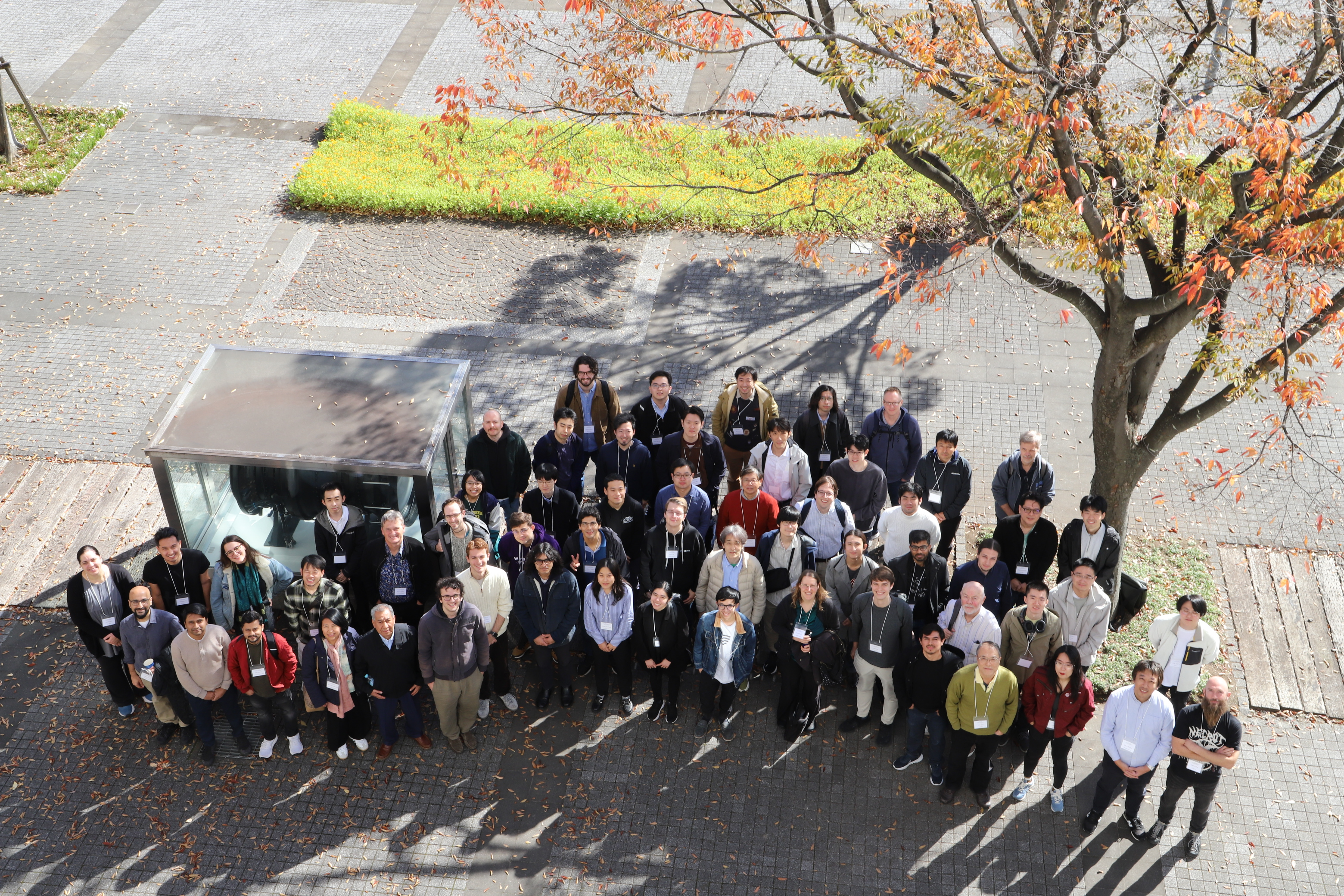
Conveners
Parallel session - Gravity II
- Chair: Xinpeng Wang
-
Russell Boey11/11/2025, 15:30
Ultralight dark matter (ULDM) is a dark matter candidate composed of light axion-like particles, and is a promising alternative to cold dark matter. A unique feature of ULDM is the formation of solitonic cores at the centre of collapsed halos, which may increase the drag experienced by black hole binaries orbiting within the soliton. We present high-resolution numerical simulations of the...
Go to contribution page -
Leo W.H. Fung11/11/2025, 15:50
Successful dark matter (DM) models have to predict the condensation of dark matter into haloes, reproducing the observed mass of galaxies and clusters in the Universe. Axionic DM, predicts an over-concentrated core 'soliton' residing within each of the haloes, which is a generic feature from models that effectively include interaction among the DM particles. This has been the major way to...
Go to contribution page -
Tomoki Takeuchi
In curved spacetime, the trajectory of a light ray is described by a geodesic under the geometric optics approximation.However, this approximation is valid only locally and is not justified int the all spacetime regions.If it breaks down, the polarization of light can affect its propagation.In this presentation, we consider light propagating through an axion field in spinoptics...
Go to contribution page -
Federico Urban
Ultra-light dark matter, a compelling candidate for the cosmological dark matter, is modelled as an oscillating classical field, existing as a superposition of nearly coherent waves of macroscopic wavelength. If ultra-light dark matter has spin 2 it would look like a (massive) continuous gravitational wave, and as such it would be detectable in gravitational wave interferometers. In this talk...
Go to contribution page