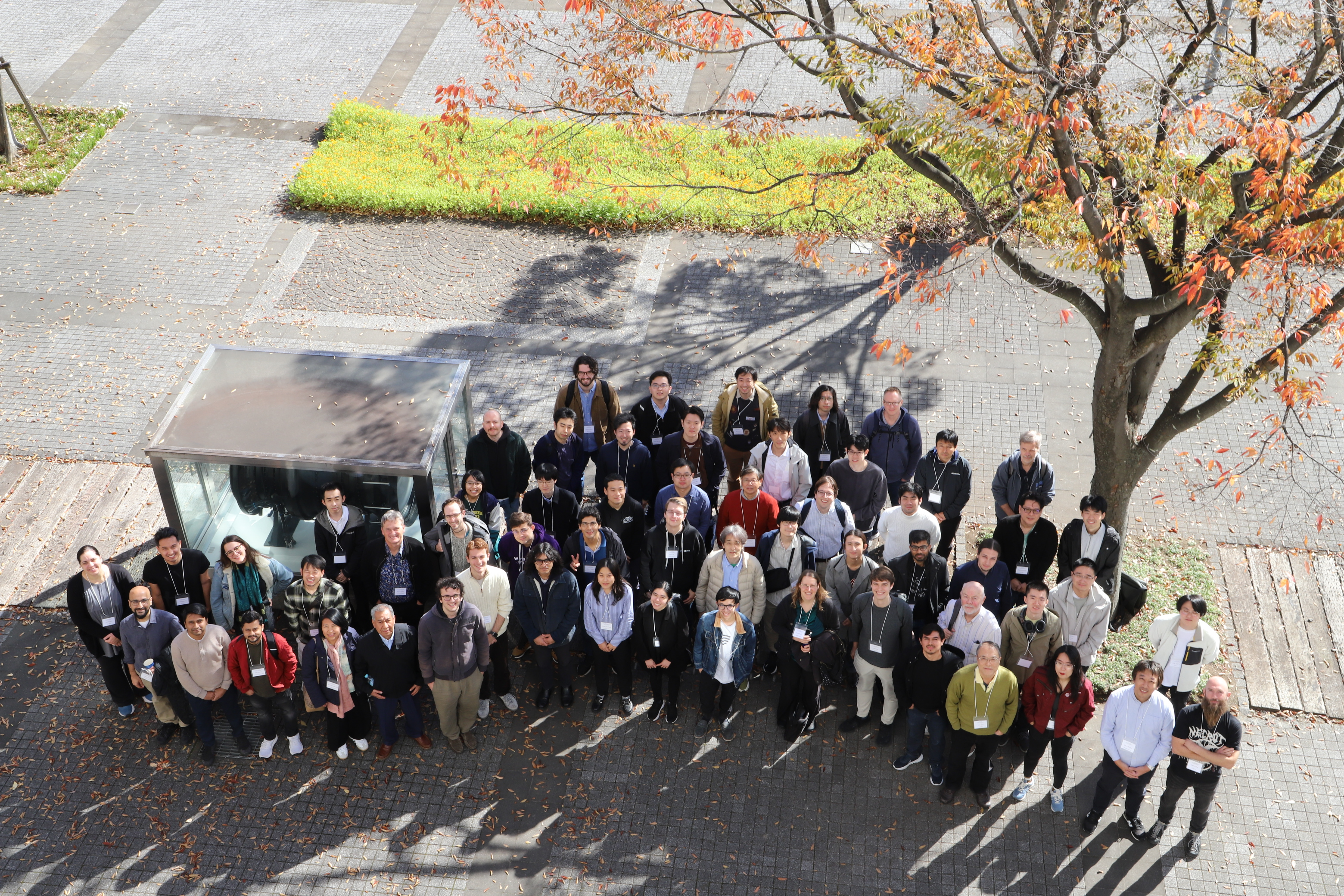
Conveners
Parallel session - Experiments II
- Chair: Baptiste Jost
-
Takumi Hasada14/11/2025, 13:40
Axion-like particles(ALPs) are attractive candidates that could explain reported excesses in the cosmic optical and infrared background. We aim to search for ALPs via stimulated resonant photon scattering by colliding three short-pulse lasers. By changing angle of incidence of the three beams, the center-of-mass-system collision energy can be varied and the eV mass range can be continuously...
Go to contribution page -
Mukesh Kumar Pandey14/11/2025, 14:00
This work presents a comprehensive theoretical investigation of dark matter (DM)–electron interactions using atomic response functions (ARFs), with a focus on Germanium and Xenon—two widely employed detectors in direct detection experiments. Accurately modeling these interactions is essential for interpreting and guiding searches for light dark matter candidates, particularly in scenarios...
Go to contribution page -
Tomoyuki Shimasaki14/11/2025, 14:20
The Belle and Belle II experiments have collected samples of e+e− collision data at and near the centre-of-mass energies near the Υ(nS) resonances. These data have constrained kinematics and low multiplicity, which allow searches for dark sector particles in the mass range from a few MeV to 10 GeV. Using samples of up to 711 fb−1 collected by Belle and 365 fb−1 collected by Belle II at the...
Go to contribution page -
Petr Satunin14/11/2025, 14:40
Firmly established in astrophysical observations, dark matter evades direct detection in experiments. Axions and axion-like particles are among the leading dark-matter candidates, and numerous attempts to detect them in laboratories have been performed. Here, we propose to advance these efforts substantially, extending the sensitivity for dark-matter axions in the mass range 38-54 mu-eV down...
Go to contribution page