Dark Matter and Gamma-Ray Astronomy: An Intersection of Astrophysics and Particle Physics

Asia/Tokyo
Lecture Hall (Kavli IPMU)

Lecture Hall

Kavli IPMU

5-1-5 Kashiwanoha, Kashiwa, Chiba, 277-8583, Japan
Naomi Tsuji (UTokyo, ICRR), Hiroki Yoneda (Kyoto University), Tadayuki Takahashi (Univ. of Tokyo)
Description

Dark Matter and Gamma-Ray Astronomy:

An Intersection of Astrophysics and Particle Physics

Date: 7-8 September 2026

Workshop venue: Kavli IPMU, Lecture Hall


Recent advances in gamma-ray astronomy are opening new opportunities to explore dark matter and related questions in particle physics. Observations across a broad energy range, from the MeV band with upcoming missions such as COSI, through the GeV band observed by Fermi, to the TeV and PeV regimes explored by ground-based observatories such as VERITAS, CTA, HAWC, and LHAASO, provide complementary windows onto the high-energy universe.

Dark matter remains one of the most important open questions at the intersection of astrophysics, cosmology, and particle physics. Gamma-ray observations play a unique role in this context, as they can probe environments such as the Galactic Center, dwarf spheroidal galaxies, galaxy clusters, and the extragalactic gamma-ray background. At the same time, interpreting these observations requires close interaction between theory, observations, and instrumentation, including studies of astrophysical foregrounds, cosmic-ray propagation, source populations, and instrumental backgrounds.

This workshop, Dark Matter and Gamma-Ray Astronomy: An Intersection of Astrophysics and Particle Physics, aims to bring together researchers working on dark matter theory, particle physics, gamma-ray observations, cosmic-ray astrophysics, direct detection, and future instruments. The workshop will place particular emphasis on theoretical interpretation, model building, and the connection between gamma-ray observations and particle-physics scenarios for dark matter and related new physics. By bringing these perspectives together, the workshop aims to develop a common language between theory, observation, and instrumentation.

The workshop will be held primarily in person to encourage face-to-face discussions. The program will be centered on invited talks; however, contributed talks will also be solicited. Please note that the number of slots for contributed presentations is limited.

Key topics include:

  • Various dark matter models, including axions/ALPs, WIMPs, and MeV-scale dark matter

  • Qubit-based and other novel approaches to direct dark matter detection

  • Gamma-ray observations from MeV to TeV and PeV energies

  • Astrophysical searches for axions/ALPs using gamma-ray sources

  • Cosmic-ray propagation and astrophysical foregrounds

  • Optical constraints on dark matter distributions

  • Connections between gamma-ray astronomy and accelerator-based studies

  • Future gamma-ray instruments and observational strategies


Invited speakers:

  • Koji Tsumura (Kyushu University)
  • Motoko Fujiwara (Kyushu University)
  • Shion Chen (Kyoto University)
  • Shigeki Matsumoto (IPMU)
  • Donggeun Tak (Kyung Hee University)
  • Shotaro Abe (Kyoto University)
  • Hiroki Yoneda (Kyoto University)
  • Ellis Owen (RIKEN)
  • Kohei Hayashi (National Institute of Technology, Sendai College)
  • Tomohiro Inada (Kyushu University)
  • Alex Kusenko (UCLA and Kavli IPMU)
  • Volodymyr Takhistov(QUP, KEK)
  • Yu Watanabe (UCLA)
  • Enrico D. Schiappacasse (Universidad San Sebastián)


Important Dates:

  • Registration deadline for the conference: August 23, 2026
  • Registration deadline for the contributed talks: August 14, 2026


Scientific Organizing Committee:

Yoshiyuki Inoue, Alex Kusenko, Shigeki Matsumoto, Tadayuki Takahashi, Naomi Tsuji, Koji Tsumura, Hiroki Yoneda

Local Organizing Committee:

Shigeki Matsumoto, Tadayuki Takahashi, Naomi Tsuji, Koji Tsumura, Hiroki Yoneda
 

Registration
Registration
Participants
  • Monday 7 September
    • 1
      Opening
    • Session 1
      • 2
        Dwarf Galaxies as Laboratories for Dark Matter Astrophysics and Particle Physics
        Speaker: Kohei Hayashi
      • 3
        Probing Dark Matter via Indirect Detection with VERITAS
        Speaker: Donggeun Tak
      • 10:30
        Coffee
      • 4
        Search for Line-Like Gamma-Ray Signals from Dark Matter in the Galactic Center with CTAO LST-1
        Speaker: Shotaro Abe
      • 5
        TBD
        Speaker: Volodymyr Takhistov (Kavli IPMU)
      • 6
        Event Level Searches for New Physics with IACTs: Ultra short gamma-ray bursts
        Speaker: Matthew Lundy
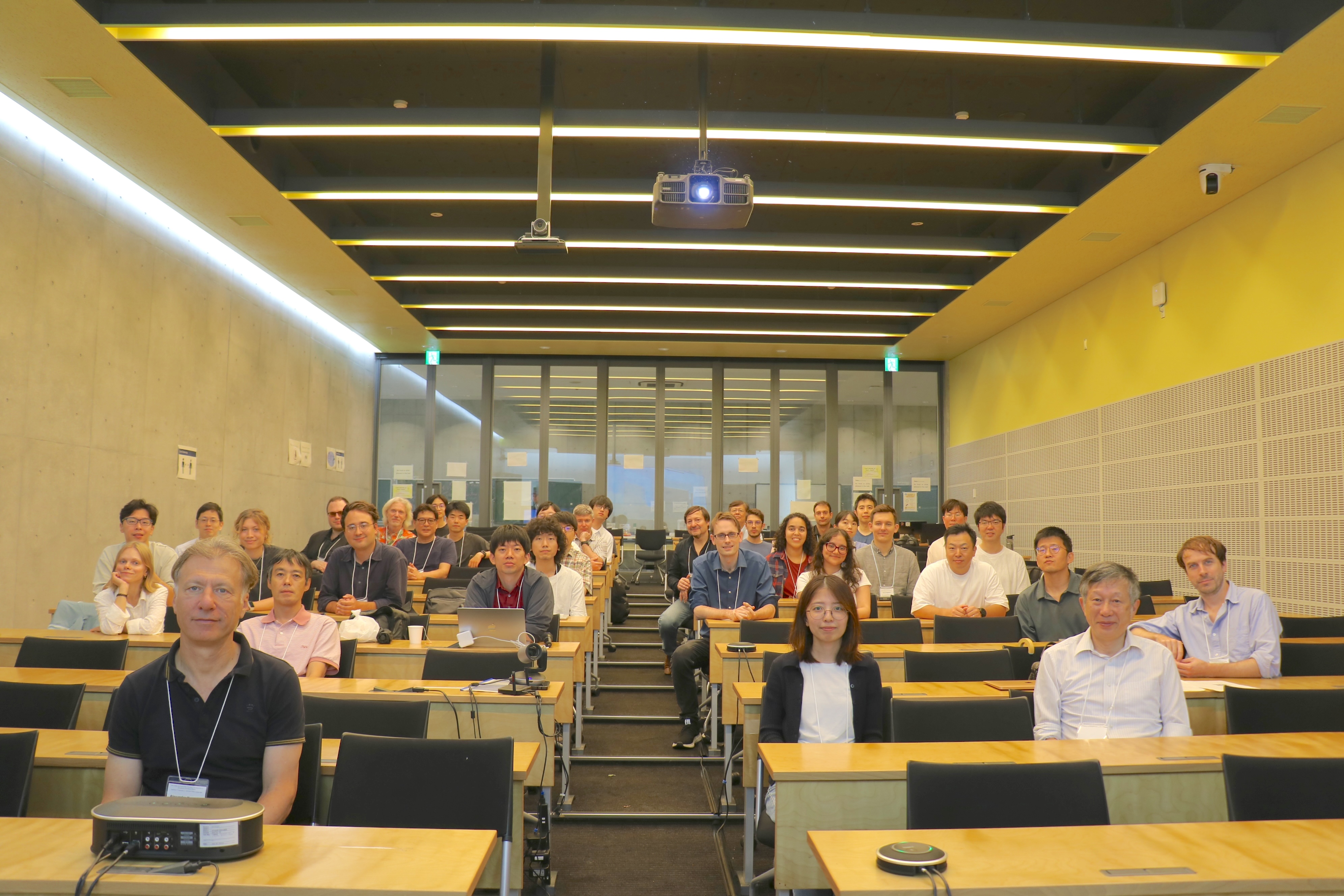
    • Photo
    • Session 2
      • 7
        Propagation of cosmic rays, including 511 keV science
        Speaker: Ellis Owen
      • 8
        TBD
        Speaker: Hiroki Yoneda (Kyoto University)
      • 9
        MeV Majoron Dark Matter from a Discrete Z_N Gauge Symmetry and Prospects for COSI
        Speaker: Subaru Fujisawa
      • 10
        Gamma-Ray Signatures of Thermal Misalignment Dark Matter
        Speaker: Hiroki Takahashi
      • 11
        Sommerfeld enhancement in an electroweakly interacting spin-1 dark matter model
        Speaker: Tomohiro Abe
    • 14:45
      Coffee
    • Session 3: ICRR seminar by Bing Liu (ICRR 6F large seminar room)

      Speaker: Bing Liu (Purple Mountain Observatory, Chinese Academy of Sciences)

      Title
      MeV Nuclear De-excitation Lines from Low-Energy Cosmic Rays

      Abstract
      Low-energy cosmic rays (LECRs) play a crucial role in the energy balance, ionization, and chemistry of the interstellar medium, thereby influencing star formation. Although direct measurements of LECRs remain challenging, next-generation MeV telescopes may enable indirect probes through nuclear de-excitation lines produced by LECR interactions with ambient gas. I will present the results on the production of MeV de‑excitation lines from various LECR sources, based on numerical nuclear reaction simulations performed with the code TALYS. Estimates are made of the expected line emission from both a point‑like CR source and passive molecular clouds, and the detectability of these lines from young supernova remnants such as Cas A is assessed. The high ionization rate in the Central Molecular Zone (CMZ) of the Galactic Center, often attributed to LECRs, is also examined. It is found that only an extremely soft CR component can account for this rate, and future MeV observations are shown to be capable of distinguishing its origin. Overall, these results demonstrate that MeV nuclear de‑excitation lines provide a powerful diagnostic for the injection, propagation, and feedback of LECRs, especially when improved instrumental capabilities become available.

  • Tuesday 8 September
    • Session 4
      • 12
        When Gravitational Waves Meet Radio Waves: A Multimessenger Hunt for Dark Matter

        We investigate multi-messenger signatures from QCD-axion ultracompact minihalos seeded by stellar-mass primordial black holes. During the inspiral of a neutron star around the central PBH, dynamical friction from the dense axion minihalo modifies the gravitational-wave phase, while axions entering the neutron-star magnetosphere can resonantly convert into narrow-band radio photons. We model the minihalo formation, adopt a conservative inner density profile together with a phenomenological phase-space distribution. We then calculate the gravitational focusing of axions near the conversion surface and determine the resulting radio and gravitational-wave signals. The combined gravitational-wave and radio observations provide a distinctive probe of both the compact and particle components of dark matter (arXiv: 2608.25338 [hep-ph]).

        Speaker: Enrico Schiappacasse
      • 13
        Searching for Dark Matter Portals at the LHC Intensity Frontier with FASER
        Speaker: Tomohiro Inada
      • 14
        Soft Collinear Effective Theory for heavy dark matter annihilation: spin-0, 1/2, and 1
        Speaker: Motoko Fujiwara
      • 10:45
        Coffee
      • 15
        MeV-scale Dark Matter Candidates in the Seesaw Scenarios
        Speaker: Shigeki Matsumoto (Kavli IPMU)
      • 16
        Fermionic Dark Matter from Milky Way and Beyond
        Speaker: Aqsa Yasmin
      • 17
        Contribution of dark matter annihilation to the diffusive extragalactic gamma-ray background
        Speaker: Junling Chen
    • Session 5
      • 18
        Projected Sensitivity of COSI to MeV Gamma-Ray Signatures from Diverse Dark Matter Candidate
        Speaker: Yu Watanabe
      • 19
        Quantum sensing application on wave-like dark matter and high-frequency gravitational wave searches

        Driven by the drastic leap of recent advancement on quantum computer development, quantum technology application is becoming aggressively sought in particle physics.
        In this talk, after the introduction the I overview a selected number of ongoing experimental efforts targeting the two primary physics search goals: wave-like dark matter and high-frequency gravitational waves.

        Speaker: Shion Chen
      • 20
        Enhanced Dark Matter Quantum Sensing via Geometric Phase
        Speaker: Xiaolin Ma
      • 21
        Listening to Inflationary Hidden-Photon Relics with Rydberg Atoms
        Speaker: Jie Sheng
      • 22
        Beyond the Minimal Pseudo-Nambu-Goldstone Dark Matter

        Pseudo-Nambu-Goldstone boson (pNGB) dark matter is a compelling
        scenario that naturally evades the increasingly stringent limits from
        direct detection experiments. The elastic scattering cross-section
        with nucleons is kinematically suppressed, allowing the model to
        remain viable while achieving the correct thermal relic abundance.
        However, the minimal pNGB realization suffers from a cosmological
        domain wall problem caused by the spontaneous breaking of a discrete
        symmetry. In this talk, we explore theoretical extensions designed to
        resolve this issue. Specifically, we discuss models that embed the
        symmetry into continuous gauge symmetries, such as U(1)_{B-L} or
        U(1)_D, as well as frameworks introducing permutation symmetries among
        multiple complex scalar fields. Finally, we will briefly discuss
        possibilities within these frameworks, including semi-annihilating and
        multi-component pNGB dark matter scenarios.

        Speaker: Koji Tsumura
    • 15:00
      Coffee
    • Session 6: APEC seminar
      • 23
        Direct detection of dark Matter in the form of primordial black holes
        Speaker: Alexander Kusenko