-
Samuel Young29/10/2025, 13:00Long talk (25min. + 10min. Q/A)
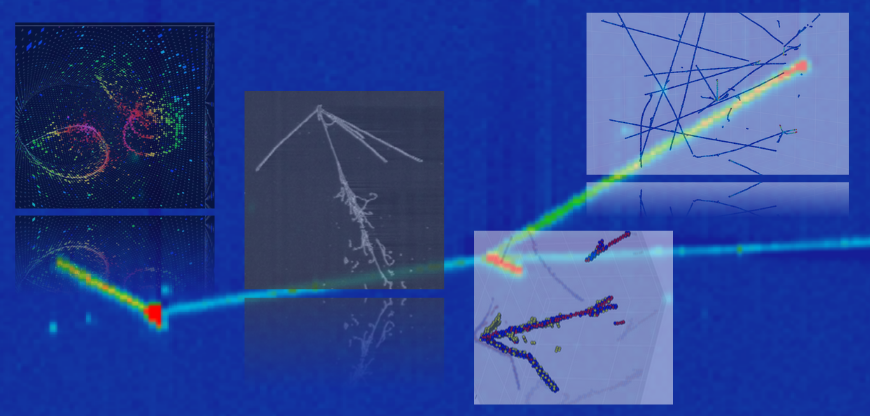
We present what to our knowledge is the first sensor-level foundation model (FM) for neutrino detectors, trained directly on simulated 3D LArTPC charge data without manual labels. The goal is simple: build a scalable model that learns the underlying physics automatically from data, then adapts to event reconstruction, PID, calibration, and other tasks using only a small labelled sample. I will...
Go to contribution page -
Fabio Cufino30/10/2025, 15:45Short talk (15min. + 5 min. Q/A)
The FASERCal detector, proposed as an off-axis neutrino detector for the FASER experiment to operate during LHC Run 4, will produce sparse, 3D voxelized data, demanding advanced deep learning for neutrino event reconstruction. We present a hybrid architecture that uses a Sparse Submanifold Convolutional Network (SSCN) to efficiently tokenize voxel hits into patch embeddings. These are...
Go to contribution page -
Zev Imani30/10/2025, 16:10Long talk (25min. + 10min. Q/A)
Given the challenges in LArTPC event reconstruction, we have taken the first steps towards creating an end-to-end inference pipeline to go from 2D images to event properties. Inspired by the success of denoising diffusion probabilistic models (DDPMs), we have developed a method of conditionally generating 2D LArTPC images. By utilizing a modified latent diffusion model, we have demonstrated...
Go to contribution page
Choose timezone
Your profile timezone: