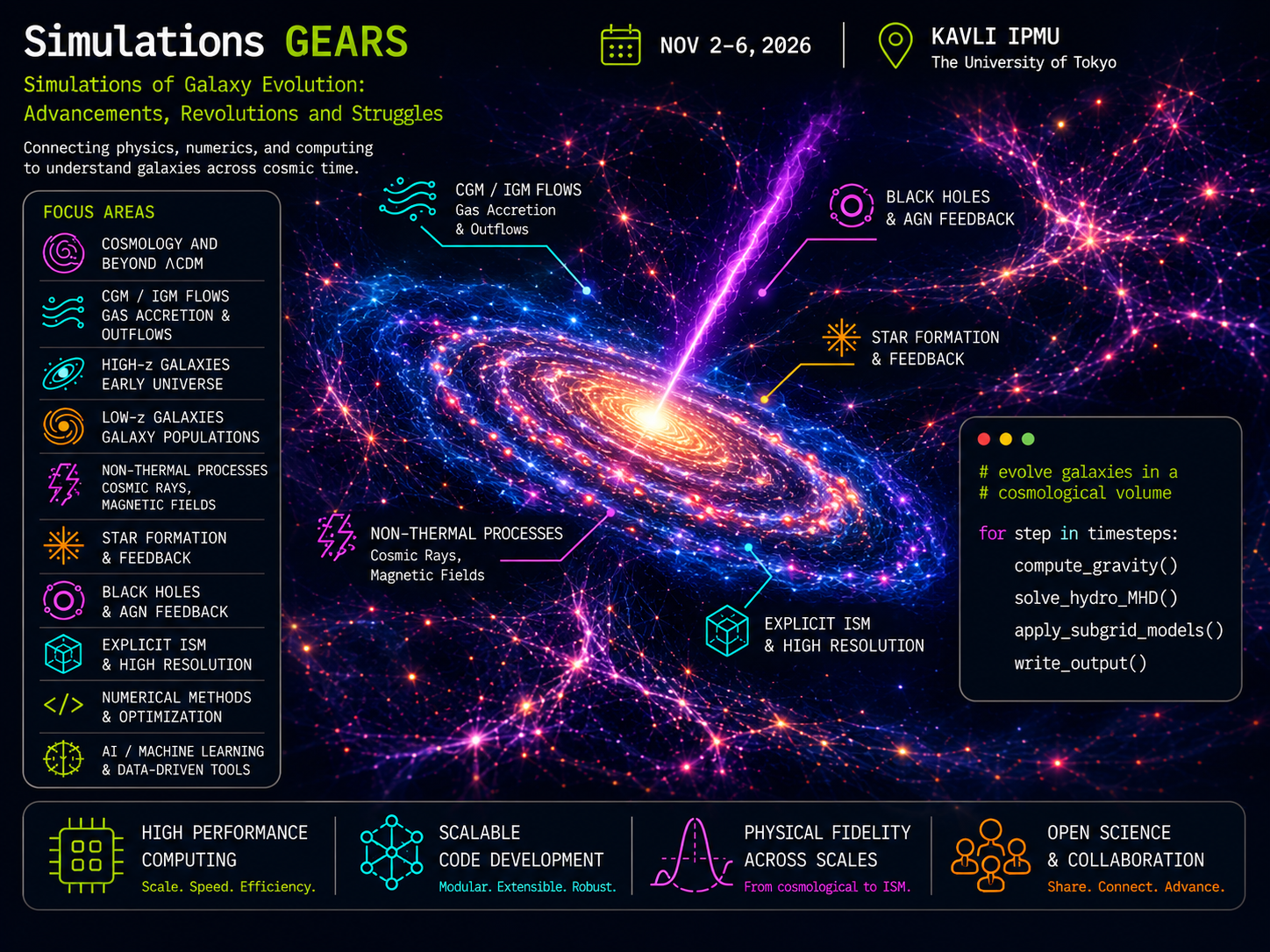
Meeting Dates & Venue
November 2-6, 2026
Kavli IPMU, Kashiwa, Chiba, Japan
Beware of any travel agency contacting you, it is a scam. We do not have agreement with travel agencies or any similar service. Trust only emails coming directly from the organizers.
Important Dates
- Submission for Expression of Interest Opens: June 4 2026 (12:00AM GMT+9)
- Submission for Expression of Interest Closes: July 5 2026 (11:59PM GMT+9)
- Notification of Contributed Talks: mid-late July 2026
- Registration closes: early-late August, 2026
- Meeting dates: Nov 2-6, 2026
Scientific Vision
Cosmological simulations have become one of the central tools for understanding galaxy formation and evolution. They connect physical models across an enormous dynamic range, from cosmological large-scale structure to black holes. Yet many of the most important advances in the field depend not only on new physical models, but also on the numerical methods, algorithms, and simulation codes that make these calculations possible.
How do different numerical methods affect galaxy formation predictions? Which aspects of feedback, black hole growth, cosmic rays, magnetic fields, and multiphase gas are robust across codes? What are the current bottlenecks in resolution, dynamic range, subgrid modeling, and computational performance? And how can new algorithmic developments, including machine learning and AI-assisted methods, contribute to the next generation of simulations?
Conference Objectives
The goal of this conference is to bring together experts working directly on the development, implementation, and application of numerical methods for cosmological (magneto)hydrodynamical simulations of galaxy formation, broadly focusing on the following science themes:
- Galaxy formation across cosmic time: high-redshift and low-redshift simulations
- The CGM, IGM, and baryon cycling in cosmological environments
- Explicit ISM modeling, star formation, and stellar feedback
- Black holes, AGN feedback, and intermediate- to supermassive black hole growth
- Non-thermal processes: cosmic rays, magnetic fields, and plasma physics
- Code development, numerical optimization, and high-performance computing
- AI, machine learning, and new algorithmic approaches for cosmological simulations
We aim to create a focused, discussion-oriented meeting where different simulation communities can compare approaches, identify shared challenges, and exchange ideas on the technical and physical ingredients that shape modern simulations. In particular, the meeting aims to:
- discuss recent advances in numerical methods for cosmological hydrodynamical and magnetohydrodynamical simulations;
- compare the strengths, limitations, and systematic uncertainties of different simulation techniques and code architectures;
- identify which predictions of galaxy formation simulations are robust across numerical implementations;
- discuss the modeling of key physical processes in galaxy evolution;
- connect simulations of different regimes, from high to low redshift and from the intergalactic to the circumgalactic medium;
- examine the challenges of explicitly resolving the interstellar medium and coupling small-scale physics to cosmological environments;
- explore recent developments in numerical optimization, high-performance computing, code scalability, and the direct use of machine learning or AI in simulation workflows;
- identify the main theoretical, numerical, and computational challenges for the next generation of cosmological galaxy formation simulations.
Invited Speakers
- Hsi-Yu Schive
- Thorsten Naab
- Ena Choi
- Shy Genel
- Tom Abel
- Dylan Nelson
- Romeel Davé
Scientific Organizing Committee (SOC)
-
Enrico Garaldi (Kavli IPMU), chair
- Rahul Ramesh (Kavli IPMU), co-chair
- Chris Byrohl (KIPAC)
-
Kentaro Nagamine (U. Osaka)
-
Marion Farcy (EPFL)
-
Matthieu Schaller (Leiden)
-
Michiko Fujii (U. Tokyo)
-
Naoki Yoshida (U. Tokyo)
-
Volker Springel (MPA)
-
Yohan Dubois (IAP)
Local Organizing Committee (LOC)
- Enrico Garaldi
- Rahul Ramesh
- TBD
Of possible interest to some of you is the "Filaments in the multi-scale Universe" conference, which will be held at Kavli-IPMU the week prior to this meeting. For more information, please visit: https://indico.ipmu.jp/event/522/
Conference information
Registration
Registration for this event is currently open.