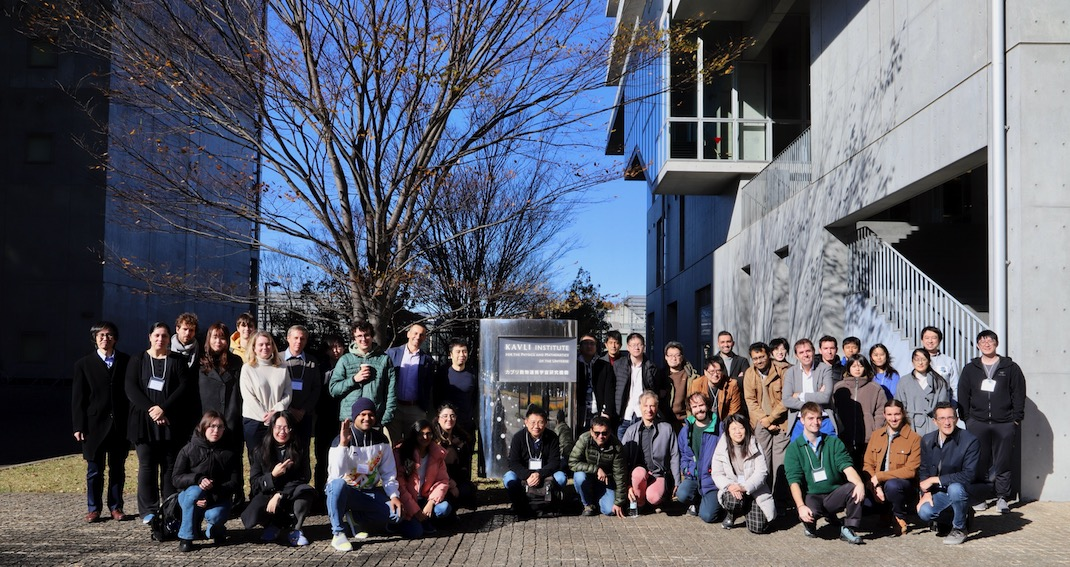
Conveners
Contributed talks
- Chair: Satoshi Shirai
Contributed talks
- Chair: Xinpeng Wang
-
Deep Ghosh01/12/2025, 15:30
Excessive dark matter (DM) capture in neutron star (NS) via DM-nucleon scattering, leads to transmutation of NS into solar mass black hole. The formation of such black hole depends on the thermal properties of captured DM particles, particularly if DM particles are bosons. In this work, we study the capture of bosonic particle and subsequent dynamics inside the star, taking the NS temperature...
Go to contribution page -
Ali Akil01/12/2025, 15:50
The accretion of dark matter (DM) into astrophysical black holes slowly increases their mass. The rate of this mass accretion depends on the DM model and the model parameters. If this mass accretion effect can be measured accurately enough, it is possible to rule out some DM models, and, with the sufficient technology and the help of other DM constraints, possibly confirm one model. We propose...
Go to contribution page -
Takashi Toma01/12/2025, 16:10
An unavoidable prediction of scenarios with Dark Matter (DM) self-interactions is the existence of number changing processes that convert $n$ initial DM particles into $m$ final ones ($n\to m$ processes), possibly accompanied by Standard Model particles. We argue that the $n\rightarrow m$ processes could be probed in DM spikes at the center of galaxies, where the high density may allow sizable...
Go to contribution page -
Yu Komiya02/12/2025, 15:30
We investigate an early history in which topological defects are dynamical within an axion cosmology post-inflation, motivated by the increasing popularity of models predicting primordial black holes formed of defects contributing to present-day dark matter content. We highlight the capabilities of the axionic context, and identify unique features pertaining to the interactions between defects...
Go to contribution page -
Philip Lu02/12/2025, 15:50
First order phase transitions can create a large mass gap between the false and true vacua for dark sector particles, effectively trapping them in false vacuum pockets. After an initial contraction phase, these particles coalesce into semi-stable compact objects, thermal balls and Fermi balls. Further cooling of these objects leads to a final collapse into primordial black holes. We show how...
Go to contribution page -
Xavier Pritchard02/12/2025, 16:10
In this talk I will give an overview of several beyond Standard model theories predicting a large number of additional degrees of freedom. The corresponding softening in equations of state can be significant. I will show that, within these models, it is then possible to achieve a large enhancement in PBH abundance on scales relevant for PBHDM; namely, the asteroid mass and memory burden windows.
Go to contribution page