AOWM × IPMU Workshop

Asia/Tokyo
Description

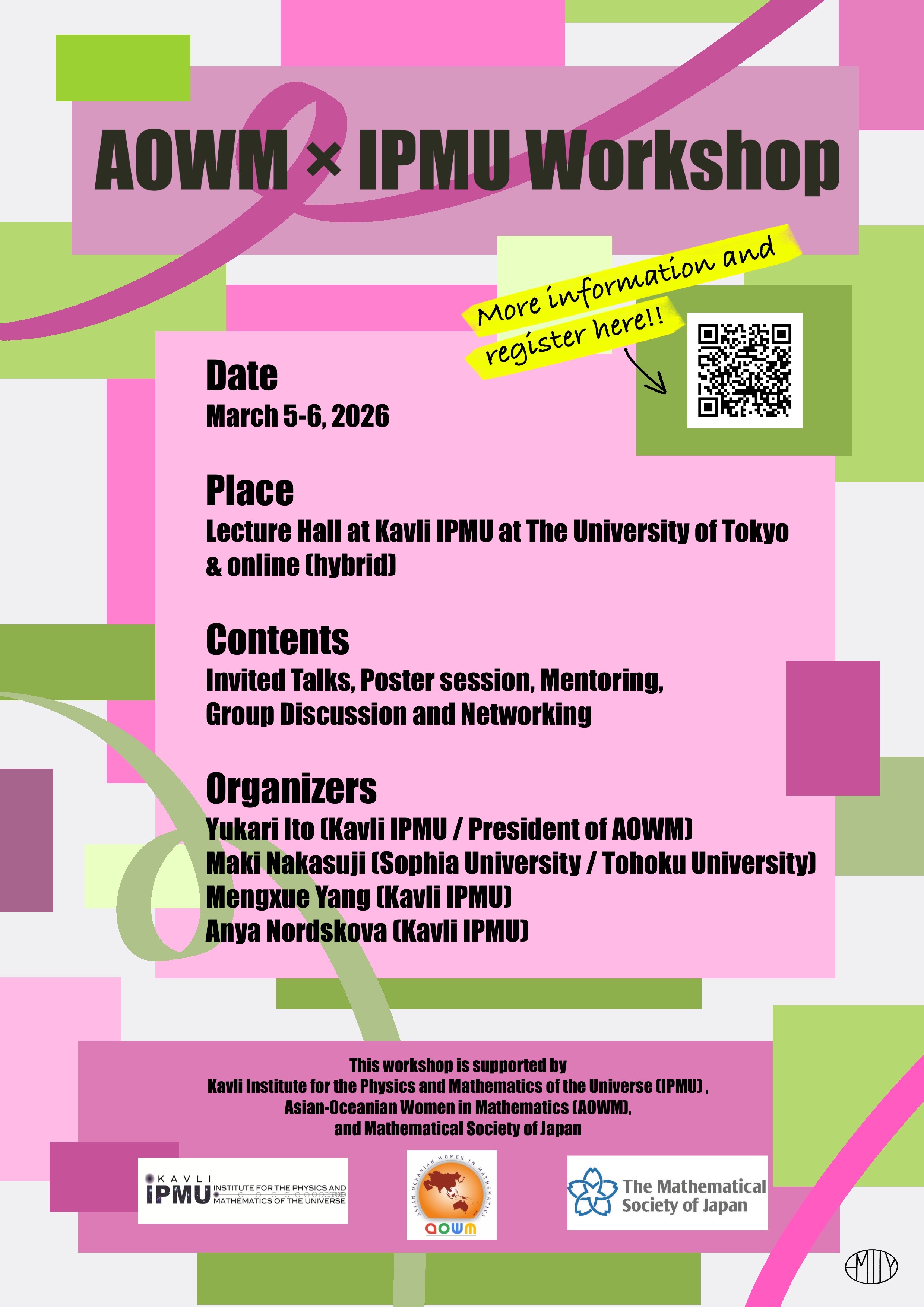
The AOWM x IPMU Workshop will be held at Kavli Institute of the Physics and Mathematics of the Universe from March 5 to March 6 in 2026.

AOWM is Asian-Oceanian Women in Mathematics, and it is an organization for women in mathematics in Asia and Oceania. However, anyone (not only women in mathematics) can attend this workshop.

We will have several invited talks and members' posters. Moreover, we will have special programs (group discussion, mentoring and networking).

Date: March 5-6, 2026

Place: Lecture Hall at Kavli IPMU & online (hybrid)

All talks in the afternoon will be hybrid.

Poster & Group discussion are held only onsite.

Invited speakers: Mathematical and Special talks

  • Yng-Ing Lee (National Taiwan University) 
  • Soon-Yi Kang (Kangwon National University)
  • Thi Ha Duong Phan (Vietnam Academy of Science and Technology)
  • Sanoli Gun (IMSc, Chennai)
  • Yoshie Sugiyama (Osaka)
  • Yukari Ito (Kavli IPMU)


Poster session: We accept applications for up to 20 posters. (onsite only!) Poster submission was closed!

Dinner: March 5 18:00-20:00 (at or near Kavli IPMU)

Registration: Please register here by February 26.


Program (Printable timetable is here.)
March 5

AM 10:00-11:30  EC meeting

    Registration

PM 13:00-13:10 Opening remarks

  13:10-13:50  Thi Ha Duong Phan (hybrid)

  14:10-14:50 Yng-Ing Lee (hybrid)


  15:00-16:00 Teatime & IPMU tour

  16:00-17:00 Poster session (onsite only)

  17:30- Conference dinner at Cafeteria on campus


March 6

AM 10:00-11:30 Group discussion (onsite only)

   Group Photo (for International Women's Day)

PM 13:00-13:40 Soon-Yi Kang (hybrid)

    14:00-14:40 Yoshie Sugiyama (hybrid)

    15:00-15:40 Teatime

    15:40-16:20 Mentoring Program: Sanoli Gun & Yukari Ito  (hybrid)

    16:20-16:30 Closing


PDF file of the poster is here!


Organizers:

  • Yukari Ito (Kavli IPMU / President of AOWM)
  • Maki Nakasuji (Sophia University / Tohoku University)
  • Mengxue Yang (Kavli IPMU)
  • Anya Nordskova (Kavli IPMU)


Other conferences which will be held near this workshop:


  • Thursday 5 March
    • AOWM EC meeting: EC meeintg
    • 1
      The Sandpile Model and Its Extensions: Dynamical Structures

      The Sandpile Model (SPM) was introduced in 1987 by the physicists Bak, Tang, and Wiesenfeld to study self- organized criticality in dynamical systems. Since then, the model and its extensions have become central topics in contemporary research, particularly in mathematics, computer science, and physics.
      This talk presents the SPM and its extensions, focusing on the structure of their state spaces, as well as stability properties and convergence times - fundamental aspects of dynamical systems that provide deeper insight into their behavior.

      Speaker: Thi Ha Duong Phan (Vietnam Academy of Science and Technology)
    • 2
      Minimal submanifolds in higher codimension

      The study of minimal submanifolds has a long history. They arise naturally and have a lot of applications. There are sharp differences between properties of minimal hypersurfaces and minimal submanifolds in high codimension. For instance, in higher codimension the uniqueness and stability for solutions of Dirichlet problem of minimal surface equation no longer hold, and the solvability and smoothness of solutions are not guaranteed either. We are particularly interested in a special class of minimal submanifolds in higher codimension, called minimal Lagrangian submanifolds. Such examples in R^2n or in a Calabi-Yau manifold are called special Lagrangians. They are always volume minimizing and play an important role in Mirror Symmetry in String theory. We allow singularities in the study.

      In the first part of this talk, I will first give an introduction and overview on the subject, including possible methods to study their existence and related results. In the second part, I will focus on the continuity method and my recent project.

      Speaker: Yng-Ing Lee (National Taiwan University)
    • 15:00
      Tea Time & IPMU tour
    • Poster session

      1) Saraswati Acharya: Differential equations and their application to human body heat transfer using the finite element method.
      2) Editha Jose: Mathematics of Reaction Networks and its Applications
      3) Akanksha Gupta: Pellian Polynomials over Integers
      4) Yasuko Hasegawa: Applications of Number Theory in Various Fields
      5) Suhita Hazra: Structure of Sets With Prescribed Complexity
      6) Papiya Sur: Common divisors of totients of polynomials
      7) Deep Thakur: Some new results on Hurwitz zeta functions
      8) Luyu Zheng: Quiver braid group action for a 3-fold crepant resolution
      9) Nao Moriyama: Remarks on the minimal model theory for log surfaces in the analytic setting
      10) Naoka Karube: The moduli space of dormant opers on elliptic curves
      11) Yukino Yagi: Reconstruction of oriented matroids from Varchenko-Gel'fand algebras
      12) Fumika Mizoguchi: Nilpotent and solvable Lie algebras obtained by quivers
      13) Gaurav Kumar: Some results on the Lerch Zeta function
      14) Hikari Hanaki: The Littlewood-Richardson rule for Schur multiple zeta functions
      15) Fumi Ogihara: On the estimation of the sum of a representation function related to square-full numbers in short intervals
      16) Jyothsnaa Sivaraman: Counting ideals and its applications
      17) Dhananjaya Sahu: On higher order real zeros of Dedekind zeta functions

      Convener: 18 presentators
    • 17:30
      Conference Dinner
    • Group Discussion
    • 3
      Partitions, Eisenstein Series, and Their Applications

      This talk explores structural connections between integer partitions and Eisenstein series, with an emphasis on the arithmetic implications of modularity and quasi-modularity. As a primary example, we study generating functions arising from MacMahon-type partition variants and show that they admit quasi-modular descriptions. This framework provides effective control over their coefficients and leads to arithmetic applications, including a new expression for prime detection.

      Speaker: Soon-Yi Kang (Kangwon National University)
    • 4
      Mathematics for Advancing Cardiovascular Medicine — From Hemodynamic Analysis to Clinical Application —

      In this talk, I discuss how mathematical structures contribute to advances in cardiovascular medicine, based on ongoing interdisciplinary collaborations with cardiovascular surgeons and cardiologists.

      Starting from three-dimensional anatomical structures reconstructed from medical imaging, we perform hemodynamic analyses grounded in fluid equations and continuum mechanics. These analyses aim to provide quantitative indicators that support surgical design and clinical decision-making. As a representative example, I will introduce efforts to improve the Fontan procedure through mathematical evaluation of blood flow dynamics and energy-related measures.

      Reliable hemodynamic modeling requires more than numerical computation. Its validity depends fundamentally on the mathematical formulation of governing equations, well-posedness considerations, and in particular the appropriate treatment of boundary conditions. Boundary conditions are not merely technical specifications; they determine stability, physical consistency, and interpretability of the results. I will highlight how these theoretical aspects shape clinically meaningful analysis.

      Finally, I will briefly discuss how mechanically derived quantities can be connected to predictive frameworks, including AI-based approaches, while preserving mathematical coherence and interpretability.

      Through these examples, I aim to demonstrate that mathematics serves not only as a computational tool but as a conceptual and structural foundation for translating medical information into reliable clinical insight.

      Speaker: Yoshie Sugiyama (The University of Osaka)
    • 15:00
      Tea Time
    • 5
      Mentoring Program

      We will explain how to organize mentoring program.
      Sanoli Gun will explain about it in Indian Women in Mathematics.
      Yukari Ito will explain about Heidelberg Laureate Forum and the mentoring program.

      Speakers: Sanoli Gun (IMSc, Chennai), Yukari Ito (Kavli IPMU, U Tokyo)