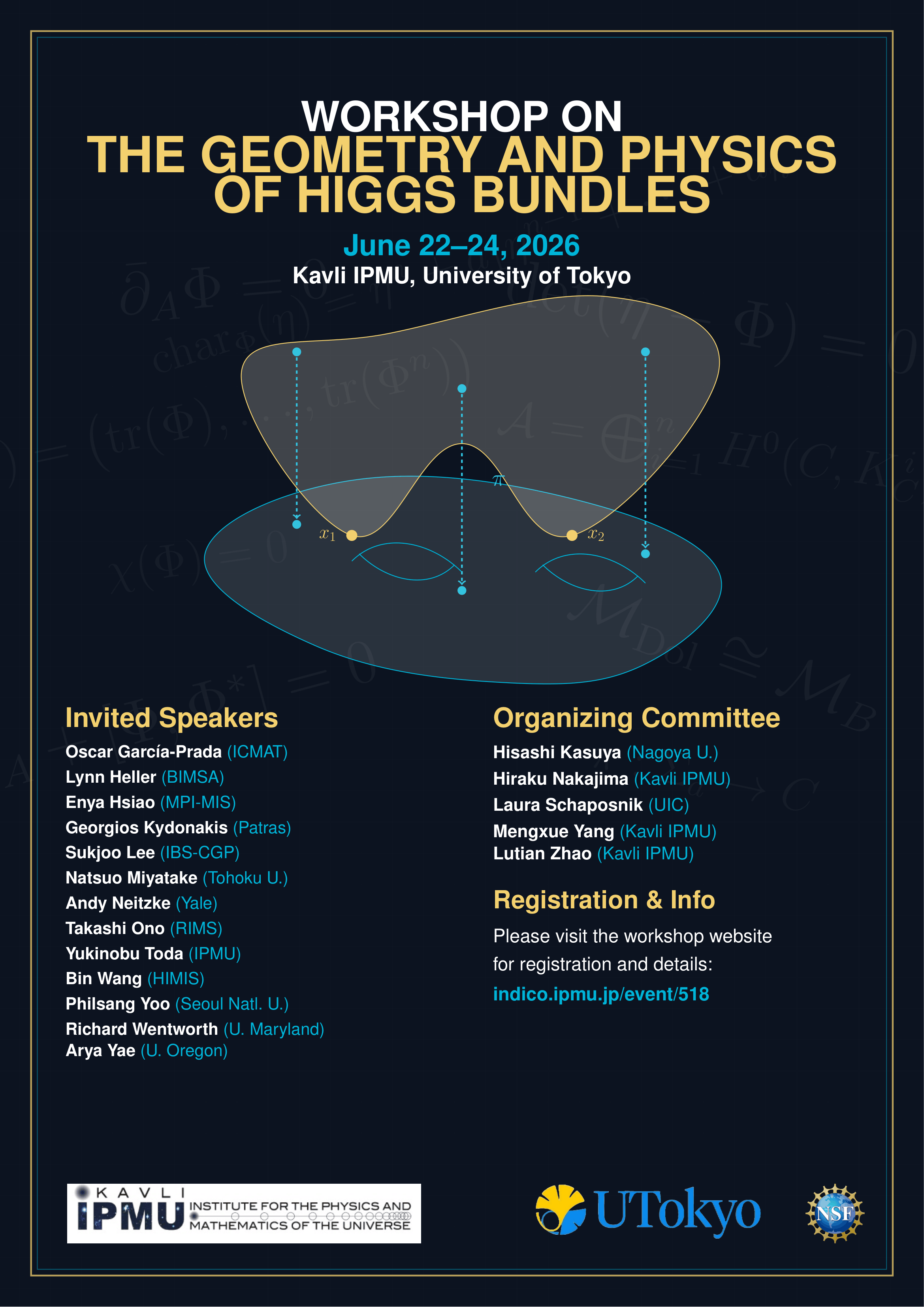
The Geometry and Physics of Higgs Bundles

Asia/Tokyo
Lecture Hall (Kavli IPMU)

Lecture Hall

Kavli IPMU

Description

Dates:  June 22 - 24, 2026

Overview:

The theory of Higgs bundles provides a unifying framework for problems in topology, representation theory, integrable systems, and quantum field theory. Over the past decades, it has formalized our understanding of non-abelian Hodge theory and the geometric aspects of physical dualities.

This meeting addresses recent progress in the moduli spaces of Higgs bundles and their physical applications. We will explore the intersection of algebraic, differential, and symplectic geometry with mathematical physics. Specific themes of the workshop include Hitchin systems, parabolic and singular structures, spectral and cameral methods, geometric Langlands duality, and their relation to supersymmetric gauge theories.

By bringing together researchers from these adjacent fields, the conference aims to clarify recent advancements and prompt new collaborative efforts at the interface of geometry and physics.

Invited speakers:

  • Oscar Garcia-Prada
  • Lynn Heller
  • Enya Hsiao
  • Georgios Kydonakis
  • Sukjoo Lee
  • Natsuo Miyatake
  • Andy Neitzke
  • Takashi Ono
  • Yukinobu Toda
  • Bin Wang
  • Philsang Yoo
  • Richard Wentworth
  • Arya Yae


Organizing Committee:

  • Hisashi Kasuya
  • Hiraku Nakajima
  • Laura Schaposnik
  • Mengxue Yang
  • Lutian Zhao


Registration:

Please note that, unfortunately, we cannot offer funding or assist with visa applications for general attendees. If you need a visa to travel to Japan, we strongly recommend arranging a tourist visa. The deadline to register is June 15 at 0:00 JST.

Venue:

Kavli Institute for the Physics and Mathematics of the Universe (Kavli IPMU),

the University of Tokyo, 5-1-5 Kashiwa-no-ha, Kashiwa City, Chiba 277-8583, Japan

Participants
    • 09:30 10:00
      Registration and Safety Training 30m
    • 10:00 10:45
      Oscar Garcia-Prada: Non-abelian Hodge correspondence and non-connected groups 45m

      The non-abelian Hodge correspondence over a compact Riemann surface X establishes a homeomorphism between the moduli space of G-Higgs bundles and the G-character variety of the fundamental group of X, for a connected semisimple complex Lie group G. Even though the group G is connected, in the study of the geometry of G-Higgs bundles, one has to deal with Higgs pairs of different sorts with non-connected structure group for which, in particular, one requires a Hitchin-Kobayashi type correspondence. This appears, for example, in the study of cyclic G-Higgs bundles, as well as in the Cayley parametrization of higher Teichmueller components. In this talk, I will explain a way of dealing with this situation, reducing the proof of the correspondence to the connected case. A particular application is an extension of the non-abelian Hodge correspondence itself to non-connected groups.

    • 11:15 12:00
      Richard Wentworth: Holomorphic isomonodromic deformations of Higgs bundles 45m

      The nonabelian Hodge correspondence relates Higgs bundles on a compact Riemann surface to representations of the fundamental group of the underlying topological surface. In this talk, I will give a characterization
      and some properties of representations where the Higgs bundles under this correspondence vary holomorphically as the Riemann surface deforms.

    • 12:00 13:15
      Lunch Break 1h 15m
    • 13:15 14:00
      Lynn Heller: Semiclassical limits of strongly parabolic Higgs bundles and hyperpolygon spaces 45m

      I will discuss joint work with Sebastian Heller and Claudio Meneses on a small-weight degeneration of the Hitchin hyperkähler metric for strongly parabolic $\mathfrak{sl}_2(\mathbb C)$-Higgs bundles on the $n$-punctured sphere. Scaling the parabolic weights to $t\alpha$ and letting $t \to 0$, we use the parabolic Deligne–Hitchin moduli space to relate twistor lines for the small-weight Higgs-bundle moduli spaces to twistor lines of the associated hyperpolygon space.

      After natural identifications with bounded regions in the hyperpolygon space, the rescaled Hitchin metrics converge uniformly on compact subsets, in fact real analytically, to the hyperpolygon hyperkähler metric. This identifies the hyperpolygon space as the finite-dimensional model for the semiclassical degeneration.

    • 14:15 15:00
      Natsuo Miyatake: Equilibrium Metrics and Complete Harmonic Metrics 45m

      Let $X$ be a compact Riemann surface. For a positive line bundle $L\to X$, a continuous Hermitian metric $e^{-\phi}h_\ast$ on $L$, and a nonpolar compact subset $K\subseteq X$, one can construct an equilibrium metric from the envelope of subharmonic weight functions bounded above by $\phi$ on $K$. The approximation of equilibrium metrics by sequences of singular metrics has been studied in a variety of contexts, including complex geometry, potential theory, dynamical systems, and probability theory.

      In this talk, I will introduce two functions, called entropy and free energy, associated with semipositive singular Hermitian metrics on the canonical bundle of a Riemann surface. These quantities are defined using an extension of the notion of complete harmonic metrics on cyclic Higgs bundles, whose existence and uniqueness were established by Li--Mochizuki, to complete Hermitian metrics associated with semipositive singular metrics on the canonical bundle that are not necessarily induced by holomorphic $r$-differentials. I will then discuss my ongoing research aimed at quantitatively establishing the principles of entropy increase and free energy decrease in various situations where an equilibrium metric is approximated by a sequence of singular metrics.

    • 15:00 15:30
      Coffee Break (3rd floor) 30m
    • 15:30 16:15
      Bin Wang: Parabolic Hitchin Systems for Classical Groups 45m

      We will discuss the geometry of strongly parabolic Hitchin systems for classical groups over smooth curves. We begin by relating the singularities of generic spectral curves to Kazhdan--Lusztig maps, and then explain how the generic Hitchin fibers can be identified with natural abelian varieties. If time permits, we will also discuss the structure of the Hitchin base for even special orthogonal groups. This talk is based on joint works with Xiaoyu Su, Xueqing Wen and Yaoxiong Wen.

    • 10:00 10:45
      Georgios Kydonakis: Symplectic groups over involutive algebras and Higgs bundles. 45m

      For a possibly noncommutative finite-dimensional algebra $A$ with an anti-involution $\sigma$ many classical Lie groups can be realized as certain symplectic or orthogonal Lie groups over the pair $(A, \sigma)$. When the involutive algebra $(A, \sigma)$ is Hermitian, one can define and study the associated Riemannian symmetric space of such Lie groups. We will describe different geometric interpretations of such symmetric spaces that generalize the various models of the hyperbolic plane viewed as the symmetric space associated to the group $\mathrm{SL}_2(\mathbb{R}) = \mathrm{Sp}_2{\mathbb{R}}$. Moreover, we will explore implications of this theory in the realm of non-abelian Hodge theory using these new geometric models of the symmetric space. This is joint work with Pengfei Huang, Eugen Rogozinnikov and Anna Wienhard.

    • 11:00 11:45
      Andy Neitzke: Conformal Blocks and Abelianization 45m

      The space of Virasoro conformal blocks on a Riemann surface is a central object in conformal field theory, studied from many different points of view. I will recall what this space is and what some of its expected structures are, and then describe a new method for constructing conformal blocks, when the Virasoro central charge is c=1. Potential applications include new formulas for isomonodromic tau-functions (related to the WKB method and Higgs bundles), and the proof of a conjecture of Goncharov-Shen relating conformal blocks to quantization of cluster varieties. This is a report of joint work with Qianyu Hao and work in progress with Dawit Belayneh and Davide Gaiotto.

    • 11:45 12:00
      Group Photo
    • 12:00 13:15
      Lunch Break 1h 15m
    • 13:15 14:00
      Sukjoo Lee: Symplectic leaves of meromorphic Hitchin systems 45m

      I will discuss symplectic leaves in moduli spaces of meromorphic $GL_r$-Higgs bundles on a smooth projective curve. These moduli spaces carry natural Poisson structures, studied independently by Bottacin and Markman, and their symplectic leaves are expected to be governed by the adjoint orbits of the residues at the marked points. However, it has not been clear whether the corresponding loci of Higgs bundles are connected. The Hitchin map is also expected to restrict to a symplectic integrable system on each leaf. For general choices of residue orbits, especially non-maximal ones, this leads to the problem of describing the Hitchin base and the generic fibers. I will discuss these questions using $\xi$-parabolic Higgs bundles, which lift the condition of fixing residue orbits to compatible parabolic flag data. This is joint work with Jiachoon Lee.

    • 14:15 15:00
      Arya Yae: Star-Shaped Nakajima Quiver Varieties and Parabolic Hitchin Moduli Spaces 45m

      The parabolic Higgs bundle moduli spaces on the n-punctured sphere are hyperkahler manifolds with integrable system structures. Star-shaped Nakajima quiver varieties are hyperkahler manifolds which were used by Kronheimer and Nakajima to model ALE spaces. In higher dimensional cases, they were recently shown by Dimakis and Rochon to be quasi-asymptotically conical (QAC).

      We generalize a construction by Rayan and Schaposnik to create a map T from a given star-shaped quiver variety X to a parabolic Hitchin moduli space M. We verify that T preserves stability and we show that it is a homeomorphism onto a Zariski open subspace of M. We then prove that T preserves the natural holomorphic symplectic forms on the two spaces, generalizing work by Biswas-Florentino-Godinho-Mandini from the rank 2, full flag, strongly parabolic case to the rank r, partial flag, weakly parabolic case. Finally, we discus some interesting corollaries.

    • 15:00 15:30
      Coffee Break (3rd floor) 30m
    • 15:30 16:15
      Takashi Ono: Joint Deformation Problem of compact Kahler manifold and Higgs bundle 45m

      In this talk, I would like to discuss the joint deformation problem of a Kahler manifold and a Higgs bundle.
      I will introduce the DGLA which governs this deformation problem.
      Moreover, I will show that if the Higgs bundle is polystable with zero Chern classes, the Kuraishi space of pair (Higgs bundle, Kahler manifold) is isomorphic to the Kuranishi space of (Higgs bundle) x the Kuranishi space of (Higgs bundle) using the property of the DGLA.

    • 16:15 18:00
      Free Time 1h 45m
    • 18:00 20:00
      Conference Dinner 2h
    • 10:00 10:45
      Enya Hsiao: Odd magical triples and maximal Higgs bundles 45m

      Higher Teichmüller theory is the study of connected components in the $G^R$-character variety consisting entirely of discrete and faithful surface group representations. Under the nonabelian Hodge correspondence, various problems in higher Teichmüller theory can be approached by using topological methods on the $G^R$-Higgs bundle moduli space.

      Following recent developments of Theta-positivity on the character variety side, it has been proposed by Bradlow, Collier, Garcia-Prada, Gothen and Oliveira that the corresponding components on the Higgs bundle moduli space are characterized by Slodowy slices of magical $\mathfrak{sl}_2$-triples. In this talk, I will explain how the above framework can be extended to include the case of maximal components of a nontube type Hermitian Lie group by introducing the notion of odd magical triples, further supporting the expectation that all higher Teichmüller components arise via a Cayley correspondence.

    • 11:15 12:00
      Philsang Yoo: Calabi-Yau Geometry Behind Tensor-Product BPS Quivers 45m

      Some quivers appearing in four-dimensional supersymmetric field theory have a surprisingly simple geometric origin. I will explain how they arise from vanishing cycles of Lefschetz fibrations, and how their tensor-product structure reflects a natural operation on the underlying geometry. The aim is to discuss the geometry, algebra, and physics underlying such tensor-product quivers. This talk is based on joint work in progress with Sangjin Lee.

    • 12:00 13:15
      Lunch Break 1h 15m
    • 13:15 14:00
      Yukinobu Toda: The Dolbeault geometric Langlands conjecture for type A groups beyond the elliptic locus 45m

      I will discuss a precise formulation of the Dolbeault geometric
      Langlands conjecture, introduced by Donagi–Pantev as the classical
      limit of the de Rham geometric Langlands correspondence. On the
      automorphic side, the formulation involves limit categories, which may
      be viewed as classical limits of categories of D-modules on moduli
      stacks of bundles over curves. It predicts an equivalence between the
      derived categories of moduli stacks of semistable Higgs bundles and
      the limit categories associated with moduli stacks of all Higgs
      bundles. The definition of limit categories, as well as this
      formulation of the Dolbeault geometric Langlands conjecture, is
      motivated by categorical Donaldson–Thomas theory for Calabi–Yau
      3-folds. In particular, these categories carry semiorthogonal
      decompositions into quasi-BPS categories, categorifying BPS invariants
      in Donaldson–Thomas theory. This is joint work with Tudor Pădurariu,
      arXiv:2508.19624.
      I will then explain work in progress on the proof of the Dolbeault
      geometric Langlands equivalence for GL_r and SL_r/PGL_r over an open
      locus of the Hitchin base which strictly contains the elliptic locus.
      This gives a nontrivial case in which the relevant moduli stacks are
      not quasi-compact, and the use of limit categories is essential both
      for the formulation and for the proof.

    • 15:00 16:00
      Coffee Break (3rd floor) 1h